B1 Polish Reading Practice: A Weekend in Gdańsk (Text, Glossary, Quiz)
B1 Polish Reading Practice: A Weekend in Gdańsk (Text, Glossary, Quiz)

Reading is one of the fastest ways to move from A2 to B1. At this level you already know the basic grammar; what you need now is plenty of real sentences that show the grammar at work. In this lesson Marta tells us about a weekend trip to Gdańsk with her friend Kasia. The text is written in natural, everyday Polish, mostly in the past tense.
How to work with the text: read it once without the translation, just for the general idea. Then read it again paragraph by paragraph with the English version, and finally read it aloud. The glossary and grammar notes below explain the trickier points.
The text: Weekend w Gdańsku
| Polish | English |
|---|---|
| W zeszły piątek pojechałam z moją przyjaciółką Kasią na weekend do Gdańska. Od dawna chciałyśmy zobaczyć to miasto, ale zawsze brakowało nam czasu. Tym razem kupiłyśmy bilety na pociąg z wyprzedzeniem i zarezerwowałyśmy mały pokój w hostelu niedaleko dworca. Podróż minęła szybko, bo przez całą drogę rozmawiałyśmy. | Last Friday I went to Gdańsk for the weekend with my friend Kasia. We had wanted to see the city for a long time, but we never had enough time. This time we bought train tickets in advance and booked a small room in a hostel near the station. The journey went by quickly because we talked the whole way. |
| W sobotę rano poszłyśmy do historycznego centrum. Najpierw spacerowałyśmy po Długim Targu i oglądałyśmy kolorowe kamienice. Przy fontannie Neptuna było mnóstwo turystów, więc zrobiłyśmy tylko jedno szybkie zdjęcie. Potem poszłyśmy nad Motławę, gdzie stoi Żuraw – dawny dźwig portowy, który jest jednym z symboli miasta. | On Saturday morning we went to the historic centre. First we walked along the Long Market and looked at the colourful town houses. There were loads of tourists by the Neptune Fountain, so we only took one quick photo. Then we went down to the Motława river, where the Crane stands – an old port crane that is one of the symbols of the city. |
| Po południu zaczęło padać, więc postanowiłyśmy pójść do muzeum. Wybrałyśmy Europejskie Centrum Solidarności. Spędziłyśmy tam prawie trzy godziny i dowiedziałyśmy się wielu ciekawych rzeczy o historii Polski w latach osiemdziesiątych. Wieczorem zjadłyśmy kolację w małej restauracji niedaleko hostelu. Ja zamówiłam zupę rybną, a Kasia pierogi z grzybami. | In the afternoon it started to rain, so we decided to go to a museum. We chose the European Solidarity Centre. We spent almost three hours there and learnt lots of interesting things about Polish history in the 1980s. In the evening we had dinner in a small restaurant near the hostel. I ordered fish soup and Kasia had dumplings with mushrooms. |
| W niedzielę pogoda była dużo lepsza. Pojechałyśmy kolejką SKM do Sopotu, żeby przejść się po molo. Wiało, ale świeciło słońce, a morze wyglądało pięknie. Kasia nawet zamoczyła nogi w Bałtyku, chociaż woda była lodowata! | On Sunday the weather was much better. We took the SKM local train to Sopot to go for a walk on the pier. It was windy, but the sun was shining and the sea looked beautiful. Kasia even dipped her feet in the Baltic, although the water was ice-cold! |
| Wróciłyśmy do domu w niedzielę wieczorem – zmęczone, ale bardzo zadowolone. Na pewno przyjadę do Gdańska jeszcze raz, może latem, i tym razem zostanę dłużej. | We came back home on Sunday evening – tired but very happy. I will definitely come to Gdańsk again, maybe in summer, and this time I’ll stay longer. |
Glossary
| Polish | English | Note |
|---|---|---|
| brakowało nam czasu | we didn’t have enough time | literally “time was lacking to us”; brakuje mi czasu – I’m short of time |
| z wyprzedzeniem | in advance | kupić bilet z wyprzedzeniem |
| kamienica | town house, tenement house | a typical city building with flats |
| mnóstwo | loads of, a lot of | followed by the genitive: mnóstwo turystów |
| dźwig portowy | port crane | Żuraw literally means “crane” (the bird) |
| postanowić | to decide | postanowiłyśmy pójść – we decided to go |
| dowiedzieć się | to find out, to learn | + genitive: dowiedzieć się wielu rzeczy |
| przejść się | to go for a (short) walk | przejść się po molo – molo never changes its form |
| wiało | it was windy | from wiać – to blow |
| zamoczyć nogi | to dip your feet | literally “to wet your legs” |
| lodowaty | ice-cold | from lód – ice |
| zadowolony | pleased, happy | zadowolone – plural form for women |
Grammar in the text
1. Pojechałyśmy: the women-only “we”
Marta and Kasia are both women, so all the plural past-tense verbs end in -łyśmy: pojechałyśmy, chciałyśmy, kupiłyśmy. If at least one man were in the group, the ending would be -liśmy. The same split works for they: pojechali (men or a mixed group) and pojechały (women only, or things).
| Infinitive | my – men or mixed | my – women only | oni / one |
|---|---|---|---|
| pojechać (to go by vehicle) | pojechaliśmy | pojechałyśmy | pojechali / pojechały |
| pójść (to go on foot) | poszliśmy | poszłyśmy | poszli / poszły |
| chcieć (to want) | chcieliśmy | chciałyśmy | chcieli / chciały |
| zjeść (to eat up) | zjedliśmy | zjadłyśmy | zjedli / zjadły |
The adjective at the end follows the same logic: zmęczone, ale zadowolone (women), but a mixed group would come back zmęczeni, ale zadowoleni. All the endings are in our lesson on the Polish past tense.
2. Aspect tells the story
Look at the Saturday paragraph. The imperfective verbs spacerowałyśmy and oglądałyśmy describe the background – what was going on for a while. The perfective verbs zrobiłyśmy (zdjęcie), poszłyśmy and zjadłyśmy move the story forward, one completed step at a time. If this is new to you, read perfective vs. imperfective verbs in Polish.
3. Where to and where: do Gdańska, w Gdańsku
Direction and location use different cases. Marta goes do Gdańska and do Sopotu (genitive), but she is w Gdańsku and w Sopocie (locative). With nad (by water), direction takes the accusative and location the instrumental: poszłyśmy nad Motławę, but Żuraw stoi nad Motławą. The locative endings are explained in the locative case in Polish.
Common mistakes
- ✗ Pojechałyśmy do Gdańsku. ✓ Pojechałyśmy do Gdańska.Do is followed by the genitive: do Gdańska.
- ✗ Byłyśmy w Gdańska. ✓ Byłyśmy w Gdańsku.For location, w takes the locative: w Gdańsku.
- ✗ Poszłyśmy nad Motławą. ✓ Poszłyśmy nad Motławę.Nad + accusative for direction, nad + instrumental for location.
- ✗ Marta i Tomek pojechały. ✓ Marta i Tomek pojechali.One man in the group is enough for the -li form.
- ✗ Spędziłyśmy tam trzy godzin. ✓ Spędziłyśmy tam trzy godziny.After 2, 3, 4 the noun takes the plural: dwie, trzy, cztery godziny.
Comprehension: true or false?
Read the text again and decide whether each sentence is true (prawda) or false (fałsz). Correct the false ones in Polish.
- Marta i Kasia pojechały do Gdańska samochodem.
- W sobotę po południu padał deszcz.
- W muzeum były tylko pół godziny.
- Do Sopotu pojechały w niedzielę.
- Woda w Bałtyku była ciepła.
Show answers
- Fałsz – pojechały pociągiem (they went by train).
- Prawda.
- Fałsz – były tam prawie trzy godziny (almost three hours).
- Prawda.
- Fałsz – woda była lodowata (the water was ice-cold).
Quiz: test yourself
Why did Marta and Kasia go to the museum?
Show answer
a) Because it started to rain. – Po południu zaczęło padać, więc postanowiłyśmy pójść do muzeum.
Who can say pojechałyśmy?
Show answer
b) a group of women only – -łyśmy is the women-only form of “we”; a mixed group says pojechaliśmy.
Complete: Byłyśmy w ___. (Gdańsk)
Show answer
c) Gdańsku – w + locative for location: w Gdańsku.
Complete: Poszłyśmy nad ___. (the Motława)
Show answer
b) Motławę – nad + accusative for direction: nad Motławę.
Which verb describes the background of the story rather than a completed step?
Show answer
a) spacerowałyśmy – spacerować is imperfective – it describes an activity going on for a while.
Your turn: describe a short trip
Write 5–6 sentences in Polish about a weekend trip you have taken (or would like to take). Use at least three perfective verbs that move the story forward (pojechałem/pojechałam, zobaczyłem/zobaczyłam, zjadłem/zjadłam), one imperfective verb for the background and one sentence about the weather. If you travelled with others, check the -liśmy / -łyśmy ending.
Show a model answer
W sierpniu pojechaliśmy z żoną na weekend do Torunia. W sobotę spacerowaliśmy po starym mieście i oglądaliśmy zabytki. Było bardzo gorąco, więc często siedzieliśmy w kawiarniach. Wieczorem zjedliśmy kolację nad Wisłą. W niedzielę kupiliśmy pierniki i wróciliśmy do domu.
(In August my wife and I went to Toruń for the weekend. On Saturday we walked around the old town and looked at the historic buildings. It was very hot, so we often sat in cafés. In the evening we had dinner by the Vistula. On Sunday we bought gingerbread and came back home.)
Flashcards: travel words from the text
- z wyprzedzeniemin advance
- zarezerwować pokójto book a room
- dworzec(railway) station
- kamienicatown house
- mnóstwo turystówloads of tourists
- postanowićto decide
- dowiedzieć sięto find out
- przejść sięto go for a walk
- molopier
- wiałoit was windy
- lodowatyice-cold
- zadowolonypleased
Summary
- Read a B1 text three times: for the general idea, with the translation, and aloud.
- Women-only groups use -łyśmy (pojechałyśmy); groups with at least one man use -liśmy (pojechaliśmy).
- Imperfective verbs paint the background, perfective verbs move the story forward.
- Direction vs. location: do Gdańska / w Gdańsku, nad Motławę / nad Motławą.
- Useful travel phrases: z wyprzedzeniem, przejść się po molo, brakowało nam czasu.
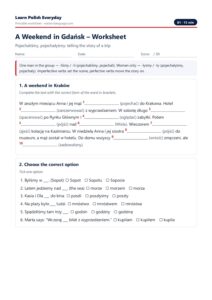
Practise this lesson on paper
A printable worksheet with exercises and an answer key on the last page (PDF, A4).
Want more Polish practice every day?
Our free course gives you short lessons with vocabulary, pronunciation practice and exercises – a good way to keep your Polish active between longer reading sessions like this one.
Planning your own trip? Learn the phrases you need in Polish public transport phrases, talk about rain and sunshine with weather in Polish, and revise verbs like dowiedzieć się and przejść się in Polish reflexive verbs with się. For an easier text, try Ola’s morning, a short story for beginners.
Ready to keep improving? The Polish Online Live Classes gives you structured daily practice with everyday situations, dialogues and texts.
This lesson was prepared by the Learn Polish Everyday team with the help of AI tools. Spotted a mistake? Let us know via the contact page.


